



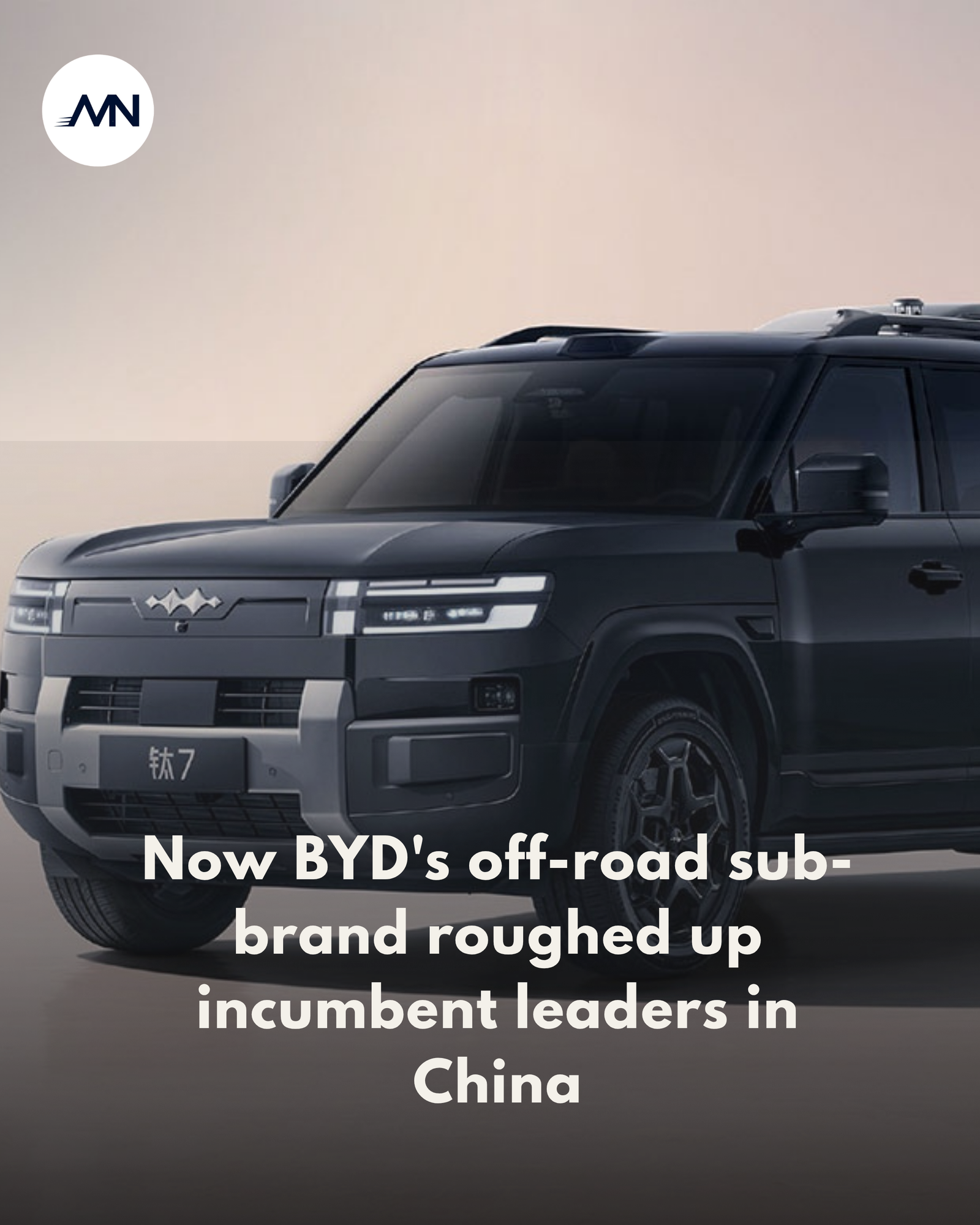
Fangchengbao, BYD's off-road subsidiary, has sold 41,213 vehicles in July, up 190.6% year-on-year — nearly tripling — and crossed 500,000 cumulative sales days after its third anniversary on August 5. Average transaction price: above ¥223,000 ($31,000), well above BYD's mass-market range, which, in China, is approximately 121,000 yuan ($16,700 USD), based on annual market data.
That last number is the real story. BYD's core brand is running into a saturated, price-war domestic market. Fangchengbao is the answer. A distinct sub-brand built for a specific segment (rugged, tech-forward off-roaders) rather than a trim level bolted onto the mainline.
It's now outselling Great Wall's Tank — the incumbent in this segment on a full-year basis (235,000 vs 230,000 in 2025), and NEV penetration in rugged off-road SUVs hit 50% in Q1 2026, up from 40% in 2025. That's a segment that used to belong entirely to combustion engines, flipping to electrified in about two years.
Worth watching if you track how legacy players (Jeep, Land Rover, Toyota's Land Cruiser line) hold this segment once it electrifies at this pace outside China too. The tell: BYD's flagship Ti9 SUV, teased this month, is expected to roll out globally under the "BYD Ti9" name after its domestic launch — the first real signal that this sub-brand's ambitions aren't staying inside China.
The mass-market EV price war gets the headlines. The premiumization play running underneath it, through sub-brands built for one segment at a time, is the one worth actually tracking.
 ‘E3 Electric Opens Its First Experience Centre In Bengaluru’